Turning a 3D twin into a command center you can press play on
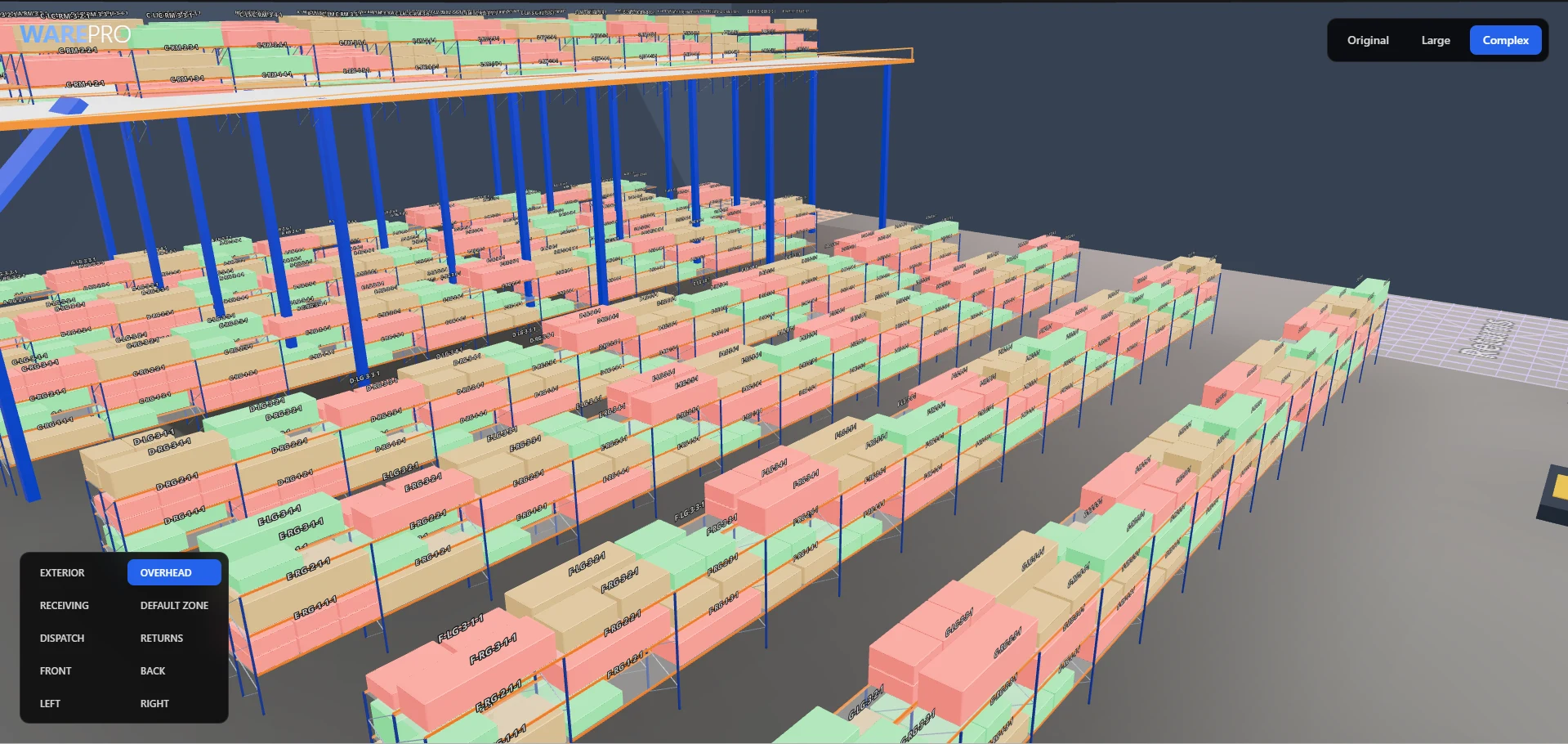
A follow-on from the WarePro digital twin: instead of a free-roam 3D scene, a scripted 10-chapter demo that pitches the idea of a warehouse command center in about ninety seconds.
- Role
- Designer & builder — concept, 3D scene, UI, scripted narrative
- Timeline
- 2026 · personal experiment
- Team
- Solo
- Platform
- Web — live at 3d-warehouse-simulator-app.vercel.app
- Status
- Live demo · scripted scenario data
The problem
The original WarePro twin proves the 3D space works, but you can't pitch “an AI command center” by handing someone a free-roam scene and hoping they find the point.
The outcome
A ten-scene scripted demo — sync, workforce, security, unified visibility — that narrates the idea for you, on a loop, with no explanation needed.
If you read nothing else
The interesting decision wasn't the 3D scene — it was replacing free exploration with a scripted, chaptered narrative so the pitch tells itself.
It fuses three things I'd built separately before — the spatial twin, AI-camera detection, predictive analytics — into one command-center screen.
This is a demo with scripted scenario data, not a connected live system, and I'm keeping that distinction explicit.
The WarePro twin proved a warehouse could be navigable in 3D. The question this experiment chased was smaller and harder: how do you make someone understand that in ninety seconds, without giving them a joystick and a shrug?
The problem with free-roam
A sandbox doesn't pitch itself
Free 3D navigation is great once you already know what you're looking for. It's a poor pitch — hand a stakeholder a camera and full freedom, and half of them never find the payoff. A command-center concept has too many things happening at once — inventory, people, vehicles, security, prediction — to trust that a first-time viewer stumbles onto the right one unaided.
The reframe
Make the demo the narrator
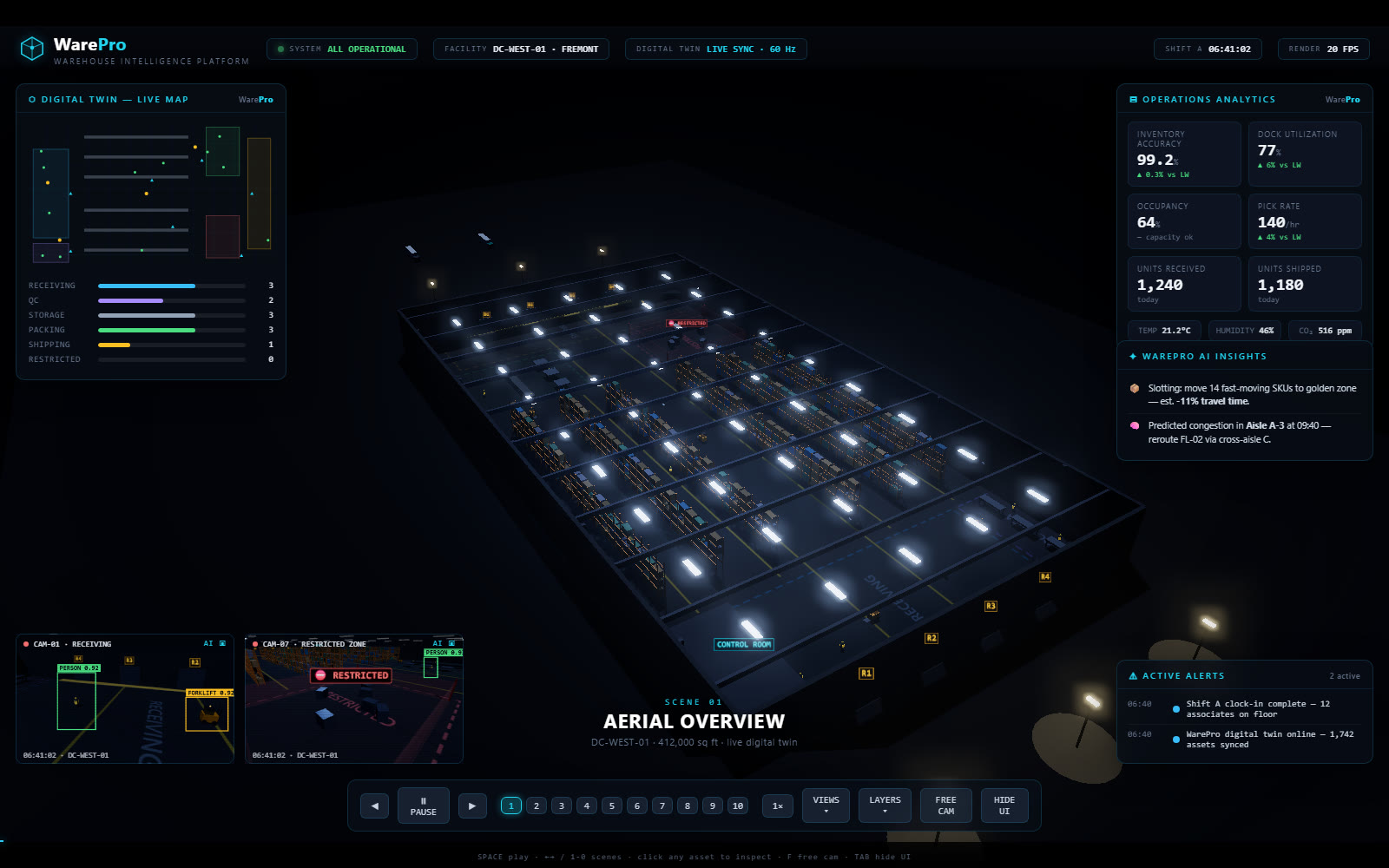
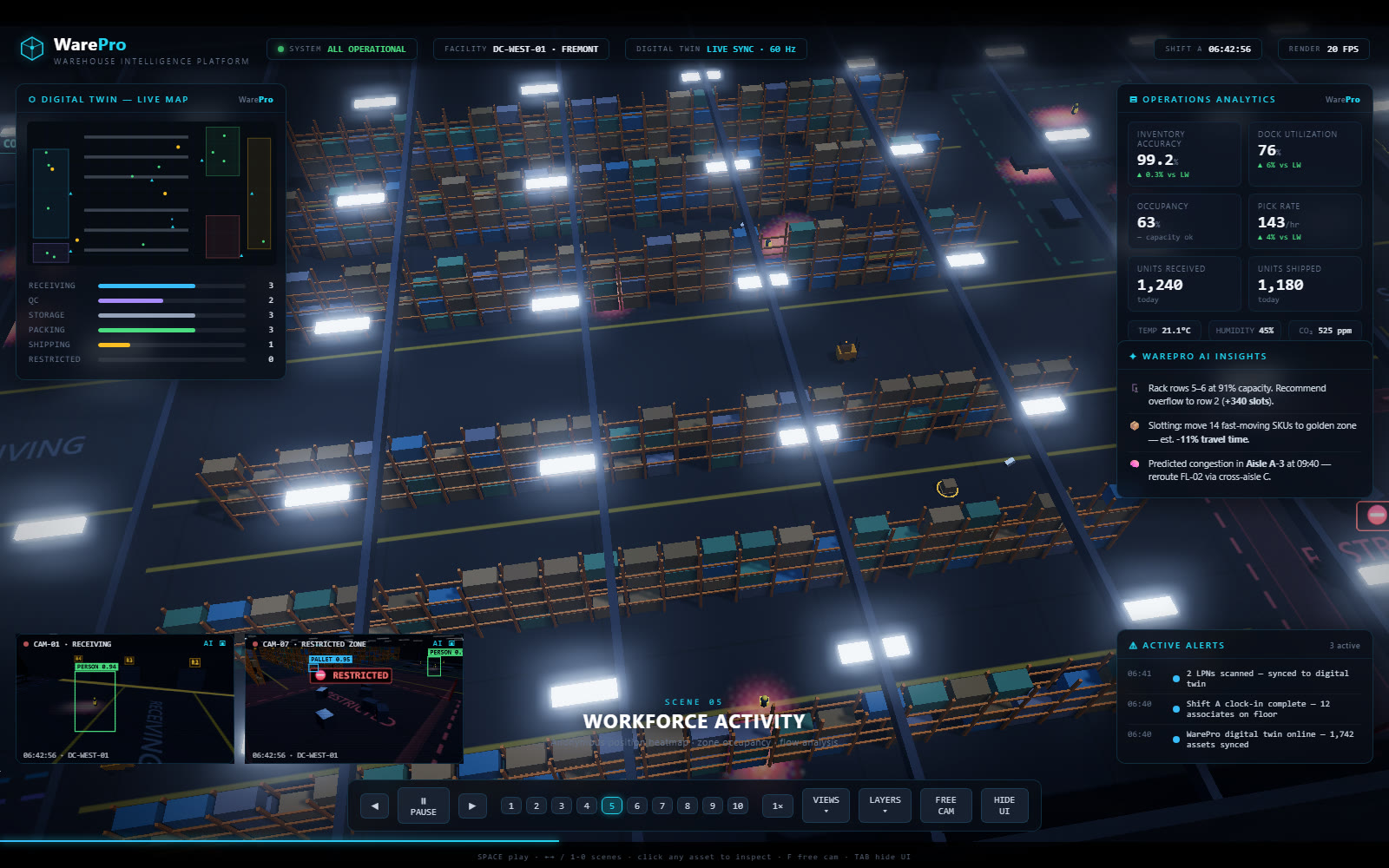
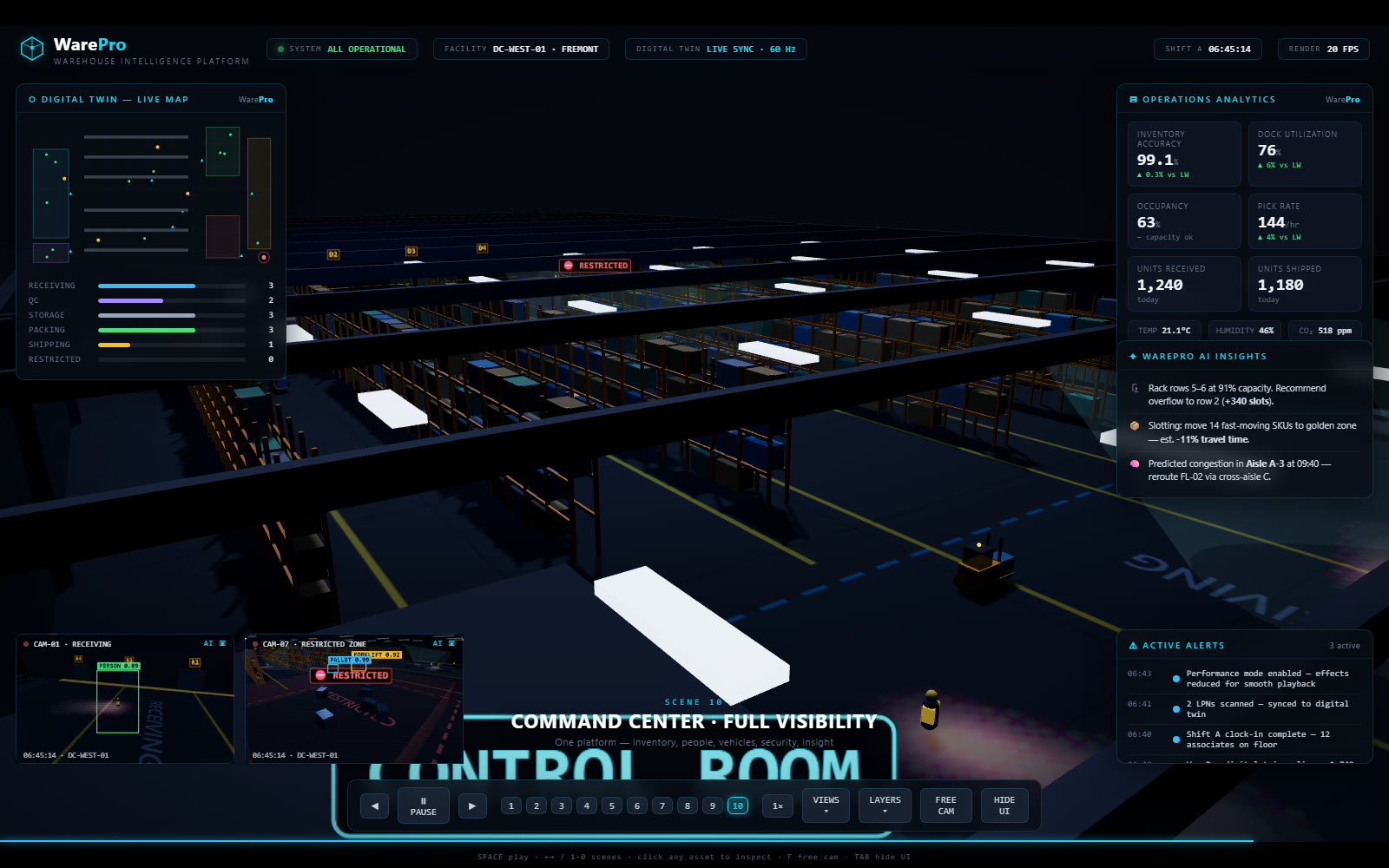
Instead of a sandbox, I scripted it: ten scenes, each with a name and a one-line thesis, playing in sequence like a guided tour with a remote control. “Digital Twin Sync.” “Workforce Activity.” “Security Event Detected.” “Command Center — Full Visibility.” Nobody has to explore to get the point; the point arrives on a timer, in order, and you can pause, rewind, or jump straight to the scene you care about.
What each scene sells
Four ideas, four chapters
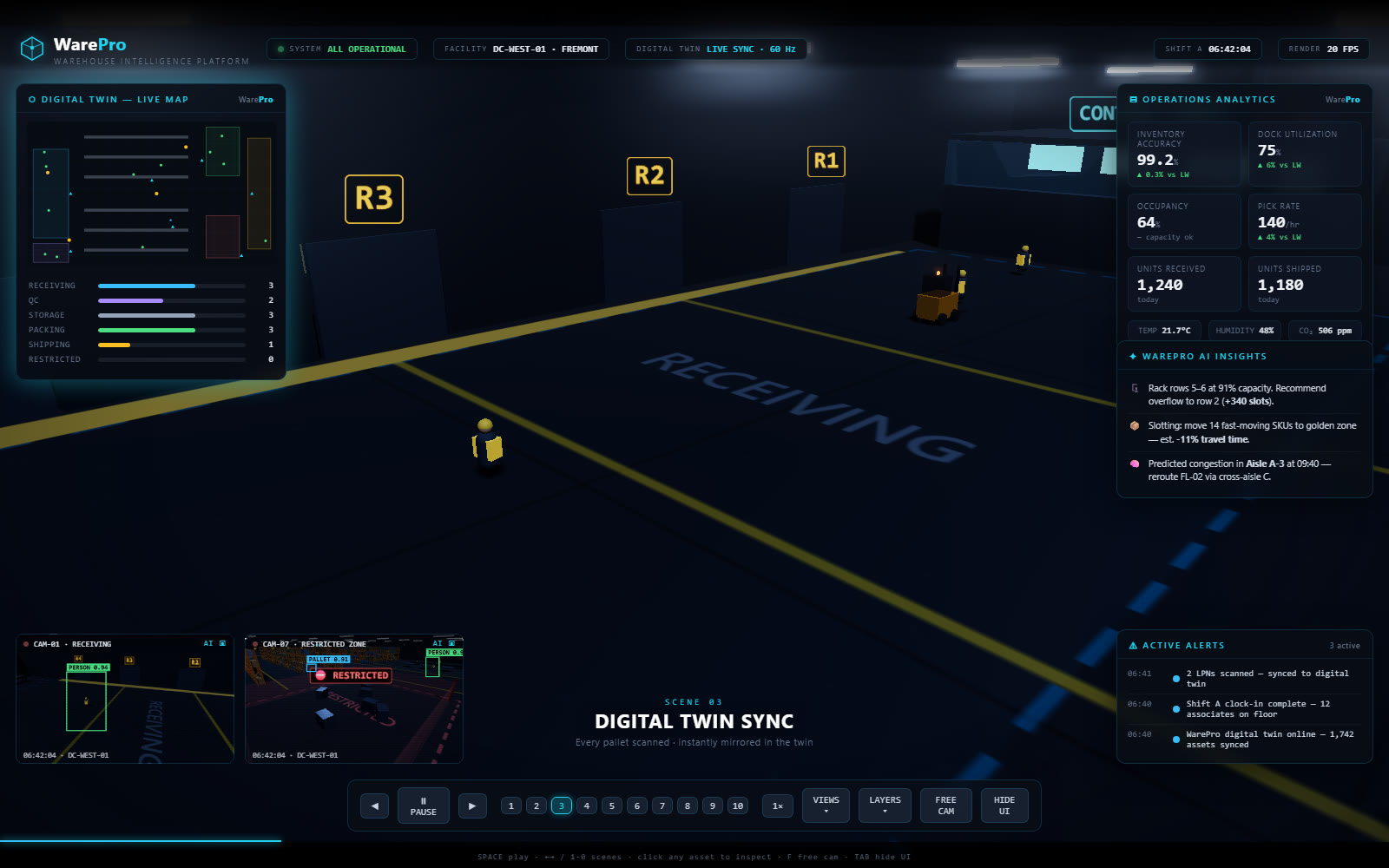
Sync establishes trust — the twin isn't decorative, it mirrors real scans in real time. Workforce activity switches to a heatmap read of the floor, because a command center's second question is always “where are people right now.”
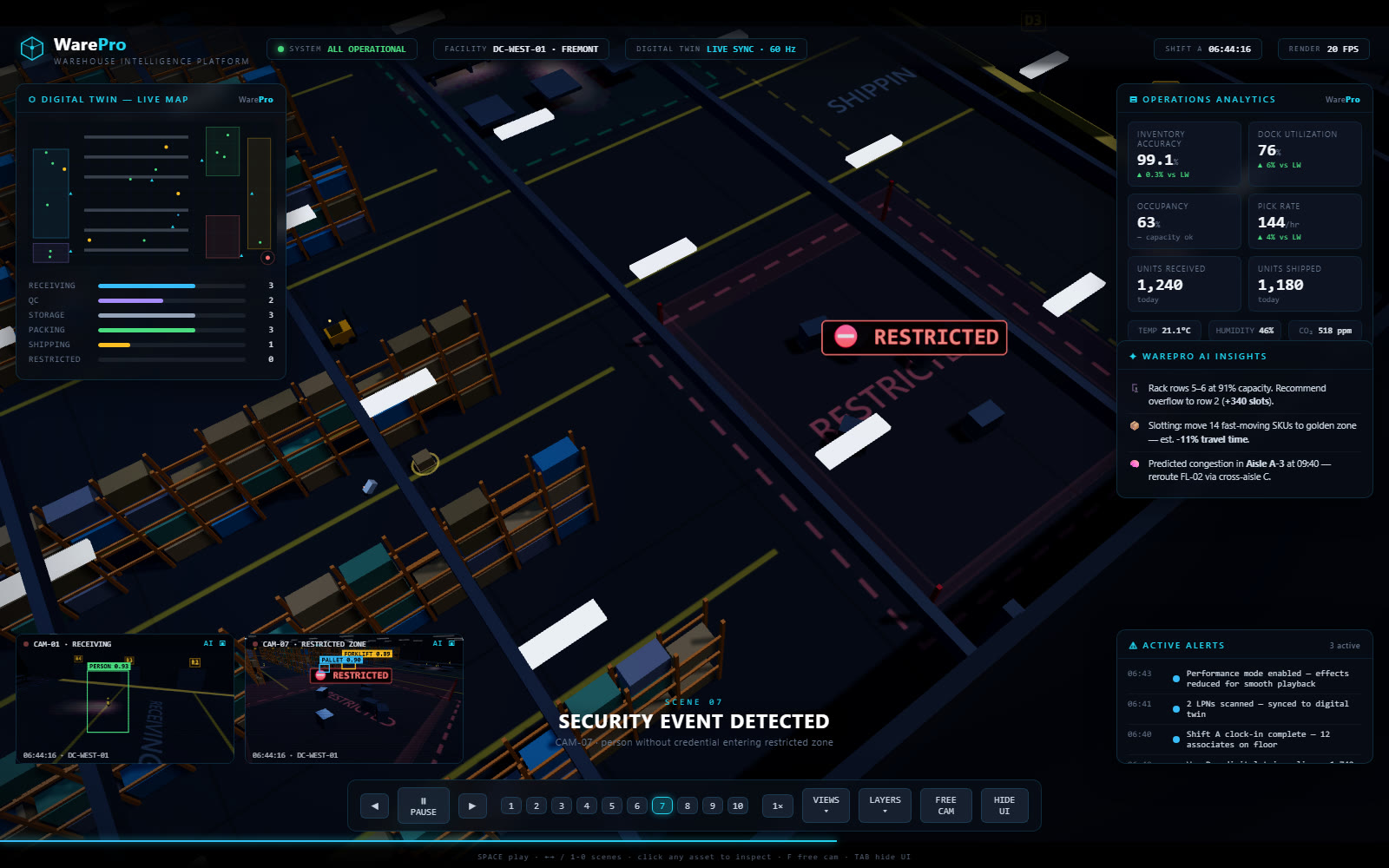
Security is the scene built to make you sit up: two AI camera feeds with live bounding boxes flag a person without credentials crossing into a restricted zone, and a red alert takes over the frame. Then Command Center closes the loop — the same screen holding inventory, people, vehicles and security together, with the line that's really the thesis of the whole thing: “One platform.”
Key decisions
What made the pitch land
A scripted sequence instead of a free sandbox
WhyA first-time viewer doesn't know what to look for in an open 3D scene. Chaptering the experience means the strongest four ideas are guaranteed to be seen, in the order that builds the argument, every single time.
AI insights phrased as recommendations, not just numbers
Why“Move 14 fast-moving SKUs to the golden zone — est. −11% travel time” does more work than a chart ever could. A raw metric asks the viewer to draw the conclusion; a recommendation states it and lets the number back it up.
Live-looking camera detection overlays
WhyBounding boxes with confidence scores (“PERSON 0.94”) are what makes computer vision legible at a glance — anyone who's seen a self-driving car demo reads that instantly as “the AI is actually watching.”
An adaptive performance mode
WhyThe scene quietly drops effects under load rather than stuttering — a small piece of engineering craft that matters because a laggy demo undercuts the exact “this is a serious platform” impression the piece is trying to create.
What this is — and isn't
What I'd build next
The gap between demo and deployment
This is honestly a pitch, not a product — the alerts, the AI insights and the camera feeds are scripted to a timeline, not wired to a real sensor or a real camera. The obvious next step is the unglamorous one: replace the script with a real event stream, so Scene 7's restricted-zone alert is a thing that actually happened rather than a beat in a demo. The narrative structure would survive that change completely unchanged — which is probably the best sign that the structure was the right call.
More case studies