The AI tutor that makes asking a “stupid question” free
Students don't stop having questions — they stop asking them. EduVerse removes the audience, so the cost of asking drops to zero.
- Role
- Founder & product designer — research, concept, IA, high-fidelity prototype
- Timeline
- 2025
- Team
- Solo
- Platform
- Web — learner dashboard & lesson player
- Status
- High-fidelity prototype · CEO backing to invest
The problem
Learners get stuck mid-lesson and don't ask. Forums and email are too slow to catch the moment, and asking publicly risks looking foolish — so the question goes unasked and the course goes unfinished.
The outcome
A lesson player with a persistent “Ask Doubts” affordance that pauses the video in under a second and opens a judgment-free AI tutor, designed so asking is easier than pushing past the confusion.
If you read nothing else
The insight isn't technical — it's social. Students don't lack access to answers, they're avoiding the embarrassment of needing one.
The AI's first line is scripted to validate the question before answering it, because the emotional barrier has to fall before the informational one matters.
Every friction point in asking was measured in seconds and removed — the video pauses in under a second, and the return path back to the lesson is always visible.
Every classroom has the same silence. Someone is lost, they know they're lost, and they say nothing — because the cost of asking isn't the question, it's the audience.
The problem
Two frictions, and only one of them is technical
The first is speed. A learner gets stuck at a precise moment, and the help available — a forum thread, an email to an instructor — arrives hours or days later, long after the moment of confusion has hardened into frustration and the course has been abandoned.
The second is the one nobody designs for. Students hesitate to ask because they're afraid the question is stupid, and that someone will notice. That fear costs more learning than any missing feature, and no amount of faster response time fixes it.
The reframe
Make asking a doubt easier than ignoring it
That sentence became the design goal for the whole product. Not “provide answers” — every platform does that — but reduce the total cost of asking, in seconds and in social risk, until it falls below the cost of staying confused. It's a behavioural target rather than a feature list, and it made the important decisions obvious.
Research
Who this is for, and what they need
What it told me
- Help has to be immediate and contextual — arriving at the moment confusion strikes, not in tomorrow's forum reply.
- The tutor has to be available around the clock, because confusion doesn't respect office hours.
- Personality matters as much as accuracy: the tutor must read as supportive and non-critical, or the fear of judgment simply transfers to the machine.
Design principles
Rules for a psychologically safe interface
Validate before you answer
The AI's first response always affirms the question. The emotional barrier is what stopped the person asking, so it has to be cleared before the explanation is worth anything.
Never make them leave
Asking happens inside the lesson, not in a separate forum or tab. Leaving the lesson to get help is itself a reason not to bother.
Show the way back
A prominent “Return to Lesson” control means asking never feels like losing your place — so there's no reason to hesitate before starting.
The core interaction
Zero-friction Q&A, in three moves
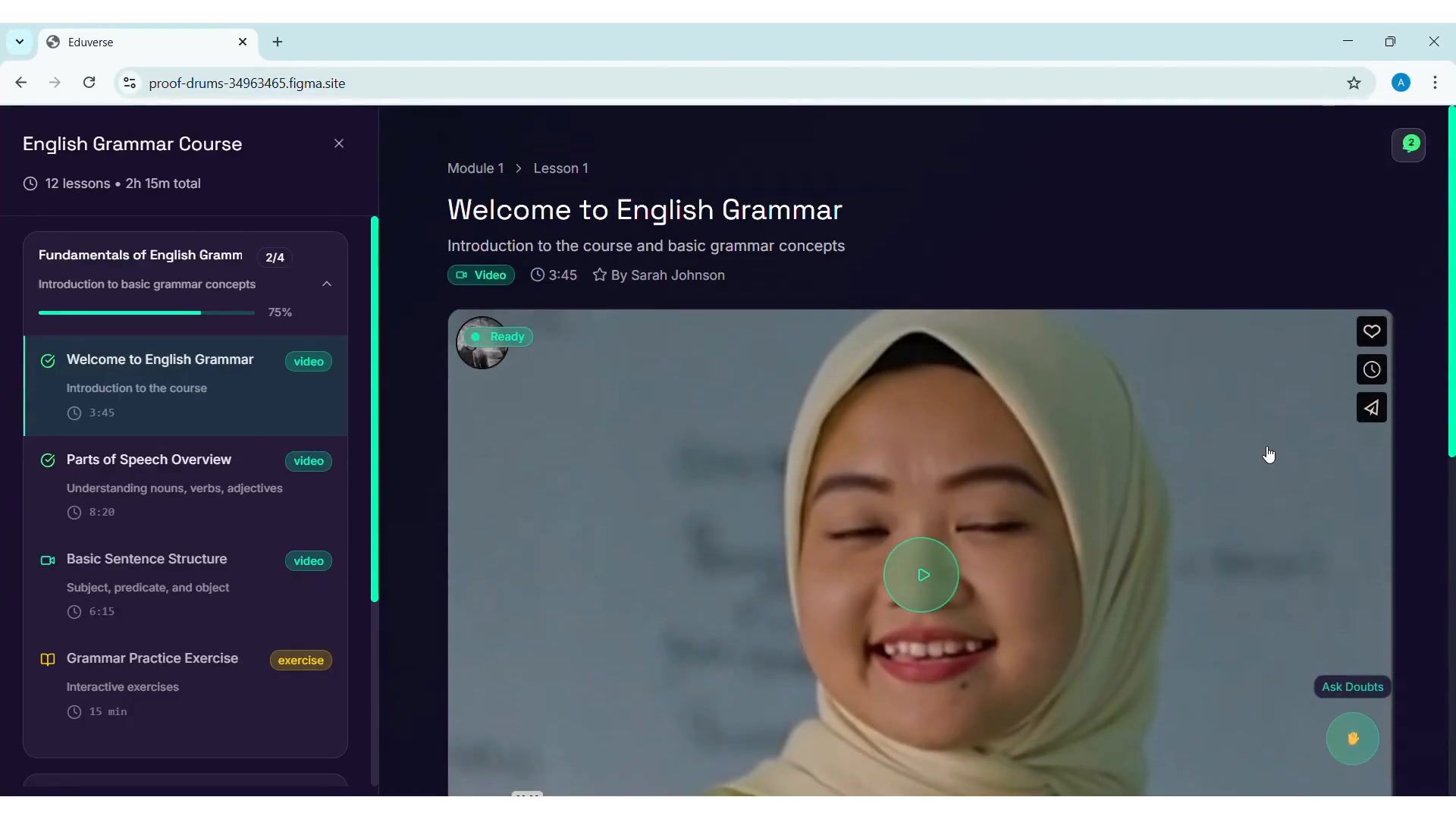
Click “Ask Doubts”
A persistent button sits in the lesson's bottom-right — always available, never demanding attention. It's placed so that noticing it doesn't require looking for it.
The video pauses instantly
The lesson stops in under a second. Any longer and the learner is managing an interface instead of holding onto the thing that confused them.
Q&A mode takes over
A conversational state opens in place, with the AI's first reply validating the question before it explains anything — and a clear route back to exactly where the lesson stopped.
Key decisions
The calls that made it feel safe
Give the AI a named personality, and show its traits
Why“Encouraging” and “Supportive” are displayed on the tutor's profile alongside its rating. Naming the temperament sets an expectation before the first question — a learner needs to believe they won't be judged before they'll risk asking.
Script the first response as validation
Why“That's an excellent question” is a design decision, not a pleasantry. The person asking has already decided the question might be stupid; the interface's job is to disprove that in the first sentence, every time.
Publish capability and limits openly
WhyResponse time, success rate and the underlying model are shown rather than hidden. Trust in an AI tutor comes from knowing what it is, and vagueness reads as something being covered up.
Let learners choose their tutor
WhyA directory of AI teachers gives agency to someone whose problem is feeling powerless in a learning environment. Choosing your own tutor is a small act of control at exactly the moment control is missing.
Gamify progress, not participation
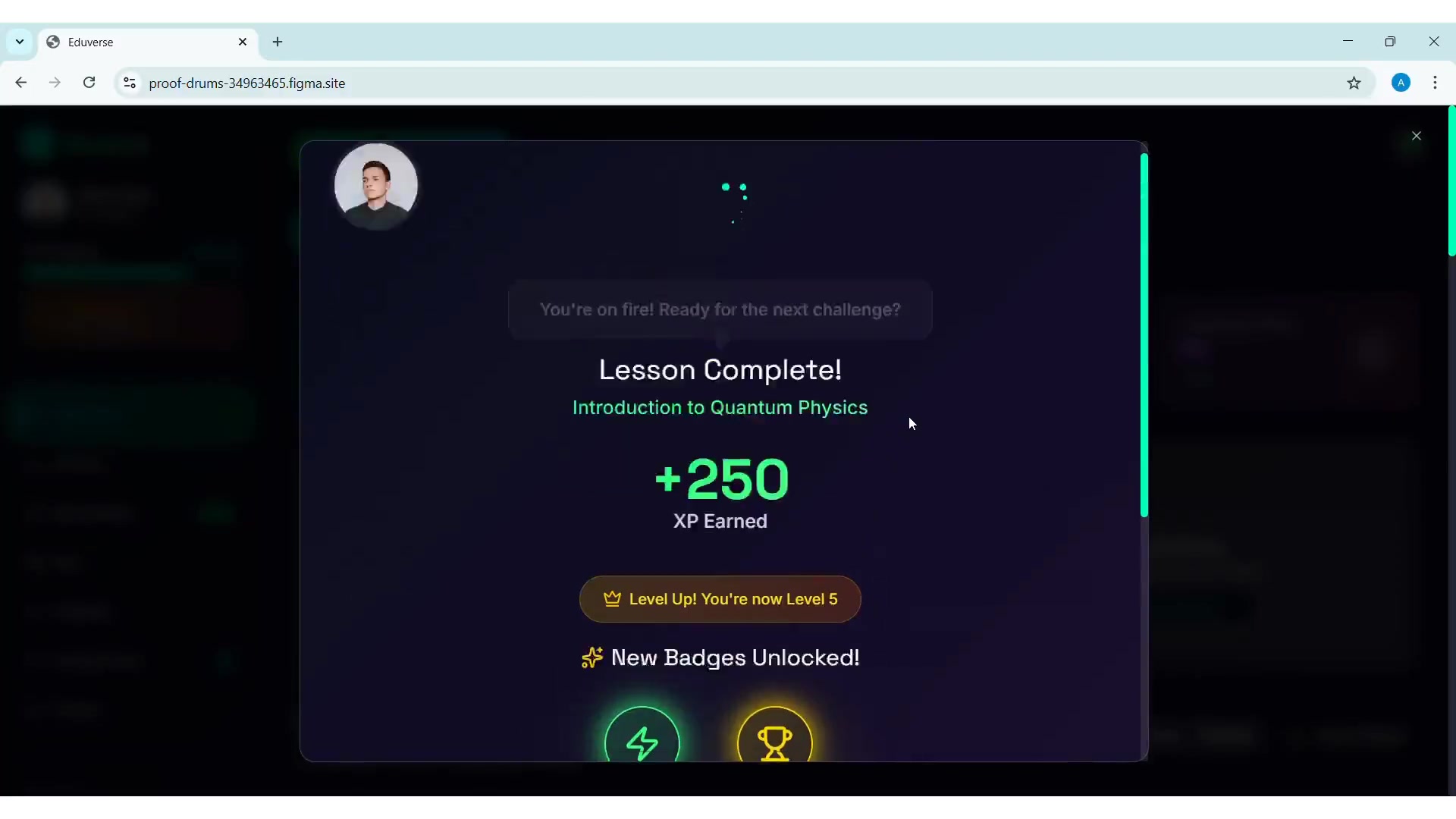
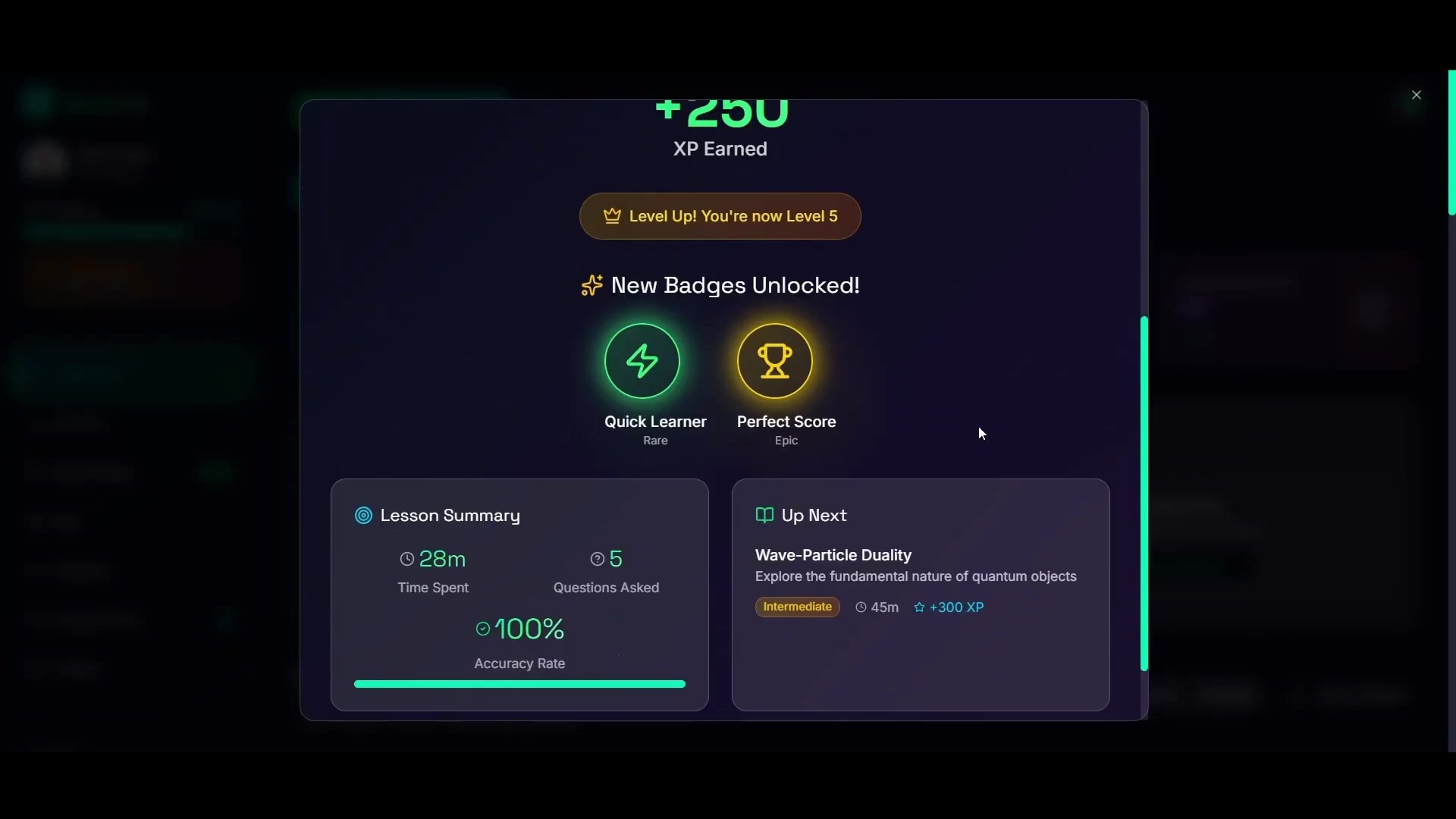
WhyXP, streaks and badges reward the learning, never the asking. Scoring questions would reintroduce exactly the performance anxiety the product exists to remove.
What it changed
The result was behavioural before it was educational
In beta testing, learners averaged roughly 4.5 AI interactions per hour-long lesson — from a baseline of essentially none — and course completion improved by around 18%. The number I care about is the first one: people who previously asked nothing started asking several times an hour. One tester summed up the whole hypothesis better than my deck did: the relief of asking “silly questions” without consequence.
Reported from beta
What I took from it
Tone did more work than content
I expected the answer quality to determine adoption. It didn't — the AI's tone and the smoothness of the transition into asking mattered more than the depth of what it said. Learners valued being told their question was reasonable almost as much as being told the answer. If I build the next version, it starts before the question does: watching for re-watching and slowed pacing, and offering help before someone has to decide whether they're willing to ask for it.
More case studies